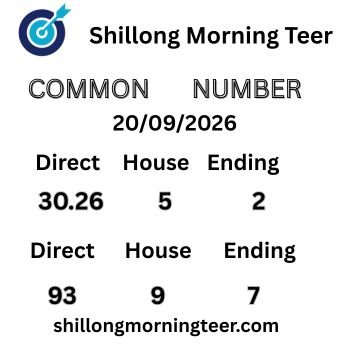

Shillong Morning Teer Common Number
Shillong Morning Teer is one of the popular morning Teer sessions followed by people interested in the traditional archery-based game in Meghalaya. Along with checking the daily result, many followers search online for terms such as Shillong Morning Teer Common Number, Morning Teer Target Number, House Number, Ending Number, FR Number and SR Number.
A common number is generally understood as a number selected or discussed on the basis of previous results, recurring digits and different calculation methods. However, it is important to understand that a common number is only a prediction or statistical reference. It cannot guarantee the result of the next round.
What Is Shillong Morning Teer?
Shillong Teer is associated with traditional archery in Meghalaya. During a Teer round, archers shoot arrows toward a target, and the final result is based on the number of arrows that hit the target. The last two digits of the relevant arrow count form the published two-digit result. MMorning Teer India+1
The Morning Teer session is commonly discussed in terms of two rounds:
- F/R – First Round
- S/R – Second Round
Several result websites describe the morning rounds as being declared around 10:30 AM and 11:30 AM respectively, although readers should verify the current schedule and result with an authoritative source before relying on a particular timing. SShillong Morning Tea Result+1
The two rounds have separate results. Therefore, an F/R number should not automatically be treated as the S/R number or as a mathematical indication of what the second round must produce.
What Does Shillong Morning Teer Common Number Mean?
The phrase common number normally refers to a number that appears repeatedly or attracts attention when previous Teer results are studied.
For example, suppose a historical result chart contains numbers such as:
12, 27, 42, 12, 58, 72, 27, 91
A person studying the chart may notice that 12 and 27 have appeared more than once. Those numbers could then be described informally as “common” within that particular sample.
This does not mean that 12 or 27 has a greater mathematical certainty of appearing in the next round. It simply describes what has happened in the selected historical data.
This distinction is important because many websites use terms such as Common Number, Target Number, Lucky Number or Sure Number differently. A responsible analysis should clearly distinguish a historical observation from a guaranteed prediction.
How Are Common Numbers Studied?
People who follow Shillong Morning Teer often study previous-result charts before discussing possible numbers. Several basic approaches can be used.
1. Previous-result frequency
The simplest approach is to count how often individual numbers have appeared during a selected period.
For example, if you examine 30 previous results, you can record how many times each two-digit number occurred. Numbers with repeated appearances may be called common numbers within that particular period.
The length of the period matters. A number may appear frequently during one week but not during a longer six-month sample.
2. House number
The first digit of a two-digit result is commonly called the House digit on Teer-related result pages.
For example:
- 24 → House 2
- 57 → House 5
- 81 → House 8
Looking at House digits can help organize historical results according to their first digit.
3. Ending number
The second digit is commonly called the Ending digit.
For example:
- 24 → Ending 4
- 57 → Ending 7
- 81 → Ending 1
A historical chart can therefore be analyzed separately for House and Ending frequency instead of looking only at complete two-digit numbers.
4. Direct number
A Direct Number refers to the complete two-digit figure.
For example, 24 is a direct number, while 2 is its House digit and 4 is its Ending digit.
Some prediction pages publish separate lists for Direct, House and Ending numbers. These categories should not be confused with one another.
Shillong Morning Teer Previous Results
Previous results are useful for understanding how the game is recorded and for creating a historical data set.
For example, one published archive lists recent Morning Teer records with separate F/R and S/R columns. Historical tables can be used to compare results by date and identify repeated numbers or digit patterns. MMorning Teer Ground
A simple analysis table can look like this:
| Date | F/R | S/R |
|---|---|---|
| Previous Day | 36 | 40 |
| Day Before | 11 | 80 |
| Earlier Day | 46 | 68 |
| Earlier Day | 58 | 71 |
| Earlier Day | 10 | 44 |
The purpose of such a table is to organize historical information. It should not be interpreted as proof that a particular number will appear next.
Why Common Numbers Cannot Guarantee the Next Result
One of the biggest misunderstandings surrounding Teer predictions is the idea that a number appearing frequently in the past must appear again soon.
That conclusion does not necessarily follow from the data.
If a number appeared several times during a particular period, its previous appearances do not force another appearance in the next round. Similarly, a number that has not appeared for several days is not automatically “due.”
The actual result comes from the arrow count in the relevant round. Since the final two digits depend on that count, historical frequency alone cannot determine the future result. MMorning Teer India
For this reason, phrases such as “100% sure,” “fixed number,” or “guaranteed result” should be treated cautiously when they appear on prediction pages.
Common Number vs Target Number
The terms Common Number and Target Number are sometimes used interchangeably on Teer-related websites, but their exact meaning can differ from one site to another.
Generally, a common number is associated with a number that appears frequently in historical results or is selected from a pattern-based analysis.
A target number may refer to a number that a particular analyst expects or highlights for a particular round.
Neither term should automatically be interpreted as an official prediction.
The official result is determined only when the relevant round has been completed and the result has been declared.
How to Make a Simple Historical Analysis
If you want to study Shillong Morning Teer results, you can follow a straightforward process.
First, collect a sufficiently large set of previous F/R and S/R results. Avoid making conclusions from only two or three days because such a small sample can be misleading.
Next, separate the numbers into House and Ending digits.
Then count:
- How many times each Direct Number appeared.
- How many times each House digit appeared.
- How many times each Ending digit appeared.
- Which numbers appeared repeatedly within the selected period.
- Whether the pattern changes when the period is extended.
For example, a person might compare the previous 7 days, 15 days and 30 days separately. If a pattern appears only in the shortest period, it may simply be a temporary fluctuation rather than a meaningful long-term trend.
Checking the Morning Result
For anyone following Shillong Morning Teer, it is important to distinguish between a prediction and the actual result.
A prediction or common-number article is normally published before the round. The official result is available only after the round has been conducted and the result has been declared.
Some websites publish live or historical result tables, but online sources can occasionally show outdated, copied or conflicting information. The official Shillong Teer website identifies itself as the official results source and warns users about unauthorized websites and YouTube channels. MMeghalaya Teer
For that reason, users should verify an important result against an authoritative source rather than relying on a social-media post or an unverified prediction page.
Shillong Morning Teer Common Number: Important Points
When reading a common-number article, keep these points in mind:
- A common number is based on historical information or a prediction method.
- Previous results do not guarantee future results.
- F/R and S/R are separate rounds.
- House and Ending digits describe different parts of a two-digit result.
- A Direct Number represents the complete two-digit number.
- A short historical chart can produce misleading patterns.
- “Guaranteed” or “100% sure” claims should not be treated as factual certainty.
- The declared result should be checked against an authoritative source.
Frequently Asked Questions
What is Shillong Morning Teer Common Number?
It is a number identified or discussed using previous Morning Teer results, frequency or other pattern-based methods. It is not an officially guaranteed future result.
What does F/R mean?
F/R generally means First Round, the first result of the Morning Teer session.
What does S/R mean?
S/R generally means Second Round, the separate second result of the morning session.
What is a House Number?
The House Number is commonly used to describe the first digit of a two-digit Teer result.
What is an Ending Number?
The Ending Number is the final digit of a two-digit result.
Can a common number guarantee a Teer result?
No. A historical pattern or prediction cannot guarantee the outcome of a future round.
Where should I check the final result?
The final result should be verified through the official or otherwise authoritative result source rather than relying solely on prediction websites or social-media posts. The official Shillong Teer website specifically identifies itself as the official results website. MMeghalaya Teer
Conclusion
Shillong Morning Teer Common Number is a popular search topic among people who follow Morning Teer results and historical charts. Common numbers are generally discussed by examining previous results, repeated Direct Numbers, House digits and Ending digits.
Historical analysis can make a result chart easier to understand, but it cannot provide certainty about the next result. A number that appeared frequently in the past can fail to appear in the next round, while a number that has appeared rarely can occur again.
Therefore, common numbers are best understood as historical or prediction-based references, not guaranteed winning numbers. Always separate a prediction from the officially declared result and verify current information through an authoritative source.
If you choose to participate in any betting activity, do so only where lawful and within limits you can afford. Avoid treating predictions, “fixed numbers” or “100% sure” claims as guarantees.