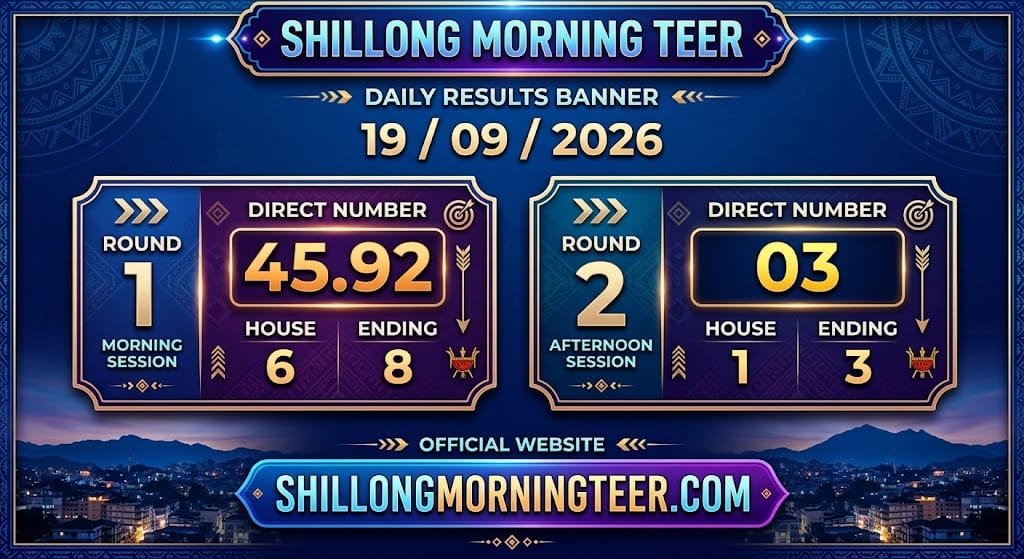

The Shillong Morning Teer is a traditional archery-based number game associated with Meghalaya and is followed by many people who are interested in Teer results, previous records, number patterns, and statistical discussions. Among the many search terms connected with the game, Shillong Morning Teer Common Number is one of the most frequently discussed topics.
Players and enthusiasts often look at previous results to identify numbers that appear repeatedly or combinations that seem to occur more often. These numbers are commonly described as “common numbers.” However, it is important to understand that previous results cannot guarantee what number will appear in a future round.
This article explains what the Shillong Morning Teer common number concept means, how enthusiasts study previous results, how result tables can be used for basic analysis, and why predictions should always be treated as uncertain.
What Is Shillong Morning Teer?
Shillong Morning Teer is a traditional archery-based Teer game connected with Meghalaya. The activity involves organized archery, and the number associated with the result is determined from the arrows counted during the designated rounds.
Unlike ordinary lottery-style games, Teer has a distinctive cultural and sporting background because archery is an important traditional activity in Meghalaya.
People who follow Shillong Morning Teer generally pay attention to:
- First-round results
- Second-round results
- Previous results
- Common numbers
- Ending numbers
- Number patterns
- Historical result charts
- Result updates
- Statistical observations
The term “common number” generally refers to a number that has appeared repeatedly in historical results or is being discussed because of its frequency in a selected collection of previous results.
What Does Shillong Morning Teer Common Number Mean?
The phrase Shillong Morning Teer Common Number can have slightly different meanings depending on how someone is analyzing the results.
In a simple sense, a common number is a number that appears multiple times in a historical result list. For example, if a particular number appears several times in the results collected over a certain period, an observer may call that number a common number.
However, frequency does not mean certainty.
Suppose a number appeared several times during the previous month. That information tells us something about the historical record, but it does not establish that the same number must appear again.
This distinction is extremely important when reading Teer-related content online.
Common Number vs. Prediction
A common number is generally based on historical observations.
A prediction is an attempt to suggest what might happen in a future round.
These are not the same thing.
For example, an article may identify numbers that occurred frequently during a particular historical period. That is a description of past data. Saying that one of those numbers will definitely appear in the next result would be an unsupported prediction.
For this reason, responsible Teer content should clearly distinguish historical statistics from future-number claims.
Why Do People Search for Common Numbers?
There are several reasons people search for common-number information.
1. Studying Previous Results
Historical results provide a record that enthusiasts can examine. Looking at several days or weeks of results may help people understand how frequently different numbers appeared.
2. Finding Repeated Numbers
Some readers are particularly interested in repeated numbers. They may create a list and count how often each number occurred.
3. Comparing Different Periods
Another common approach is to compare a recent period with an older period.
For example, someone may compare:
- The last 7 results
- The last 15 results
- The last 30 results
- Weekly results
- Monthly results
The conclusions can differ depending on the period selected.
4. Understanding Number Distribution
Historical analysis can also show whether numbers are distributed across different ranges rather than appearing in one particular section.
This can make result charts easier to understand.
How to Study Shillong Morning Teer Previous Results
A simple result table is enough to perform basic historical analysis.
Imagine a table containing the following columns:
| Date | First Round | Second Round |
|---|---|---|
| Day 1 | 85 | 36 |
| Day 2 | 56 | 83 |
| Day 3 | 14 | 09 |
| Day 4 | 97 | 73 |
| Day 5 | 27 | 72 |
From a table like this, an observer can count how many times each number occurred.
In this example, 67 appears several times. Therefore, within this small sample, it could be described as a frequently occurring or common historical number.
But the sample is too small to establish any meaningful future prediction.
This illustrates an important principle: frequency is descriptive, not predictive.
How Common Number Lists Are Created
A common-number list can be created using a straightforward process.
Step 1: Collect Historical Results
Start with a reliable record of previous Shillong Morning Teer results.
The longer and more accurate the dataset, the more useful it can be for descriptive analysis.
Step 2: Separate the Rounds
If the game has multiple rounds, analyze each round separately where appropriate.
Combining everything into one list can hide differences between rounds.
Step 3: Count Each Number
Count how many times each number occurred during the selected period.
For example:
| Number | Historical Occurrences |
|---|---|
| 12 | 3 |
| 27 | 5 |
| 44 | 2 |
| 61 | 4 |
| 73 | 6 |
In this hypothetical example, 73 has the highest frequency in the selected dataset.
Again, this does not mean that 73 is more likely to appear in the next round. It only means that it occurred more frequently within that particular historical sample.
Shillong Morning Teer Common Number Chart
A chart can make historical information easier to understand.
A basic chart might include:
- Date
- First-round result
- Second-round result
- Repeated numbers
- Frequency
- Last-digit frequency
- Selected historical period
For SEO websites covering Teer-related searches, presenting information in a clean table can be more useful than publishing a long list of unexplained numbers.
Readers can quickly compare results and understand how a number was selected for historical discussion.
Why Previous Results Cannot Guarantee Future Results
One of the biggest misconceptions surrounding number games is that a number that has appeared frequently must continue appearing.
This is not necessarily true.
If a number appeared five times in a historical dataset, its previous frequency does not create an obligation for the same number to appear in a future round.
Likewise, a number that has not appeared for several days does not automatically become “due.”
This is sometimes called the gambler’s fallacy: the belief that past independent outcomes must somehow compensate for recent results.
Historical results can be interesting to study, but they should not be treated as a guaranteed method for determining future results.
Hot Numbers and Cold Numbers
Teer discussions sometimes use terms such as hot number and cold number.
A hot number usually means a number that has appeared relatively frequently during a selected period.
A cold number generally refers to one that has appeared less frequently or has not appeared recently.
These terms can be useful for describing a dataset, but they should not be interpreted as proof of future performance.
For example, if number 46 appears frequently over ten historical results, it may be classified as “hot” for that particular dataset. If it does not appear during the next ten results, that would not contradict the historical calculation.
The classification depends entirely on the period and data being studied.
Ending Number Analysis
Another popular method discussed by Teer enthusiasts is ending-number analysis.
Instead of examining complete two-digit numbers, readers may focus on the final digit.
For example:
- 12 ends in 2
- 37 ends in 7
- 54 ends in 4
- 68 ends in 8
An analyst can count how frequently each ending digit appears.
A sample table might look like this:
| Ending Digit | Occurrences |
|---|---|
| 0 | 4 |
| 1 | 6 |
| 2 | 5 |
| 3 | 3 |
| 4 | 7 |
| 5 | 4 |
| 6 | 8 |
| 7 | 5 |
| 8 | 6 |
| 9 | 2 |
This can provide an interesting description of the historical dataset.
However, a frequently occurring ending digit does not guarantee that it will occur in the next result.
First Round and Second Round
Shillong Morning Teer results are commonly discussed according to their separate rounds.
Keeping the rounds separate can make historical analysis easier.
For example, a website might publish:
First Round
Historical results can be listed by date and analyzed for frequency.
Second Round
The second-round historical record can be analyzed separately.
Combined Historical View
An optional combined analysis can then show overall frequencies.
Separating the data reduces confusion and allows readers to understand exactly which result set is being discussed.
How to Verify Shillong Morning Teer Results
Anyone following Shillong Morning Teer should verify results through reliable and appropriate sources.
When reading an online result article, check:
- The date of the result.
- The round being reported.
- Whether the number has been entered correctly.
- Whether the result has been updated.
- Whether the source clearly distinguishes historical information from predictions.
This is particularly important because result websites can sometimes publish information at different times.
A responsible article should avoid presenting an unverified number as an official result.
Common Number Does Not Mean Sure Number
The phrase common number can sometimes be misunderstood.
A number may be common because it appeared frequently in historical records. It does not mean:
- Guaranteed number
- Fixed number
- Sure-shot number
- Confirmed future result
- Certain winning number
These distinctions should be made clear whenever Teer information is published online.
There is no reliable way to guarantee a future Teer result simply by looking at previous numbers.
Using a Larger Historical Dataset
If someone wants to study number frequency for educational or statistical purposes, using a larger dataset is generally more informative than using only a handful of results.
For example, an analyst could collect 30, 60, or 100 historical results and calculate:
- Frequency
- Percentage occurrence
- Most frequent historical numbers
- Least frequent historical numbers
- Ending-digit distribution
- First-round frequency
- Second-round frequency
A larger dataset can reduce the influence of unusual short-term fluctuations.
However, even a large historical dataset does not provide certainty about an individual future outcome.
Why Short-Term Patterns Can Be Misleading
Imagine a number appearing three times within five results.
It may look significant when viewed over those five results. But if the analysis is expanded to 100 results, that number may no longer stand out.
This is why the selected time period matters.
A website discussing common numbers should ideally mention the period used for its calculation.
For example:
“Historical frequency based on the previous 30 recorded results.”
This is much clearer than simply saying:
“These are today’s guaranteed common numbers.”
The first statement describes data. The second makes an unsupported certainty claim.
Responsible Approach to Teer-Related Information
Teer involves money for participants in relevant contexts, so responsible behavior is important.
Readers should treat number charts and historical statistics as informational material rather than financial advice or a guarantee of winnings.
People should:
- Set a personal spending limit.
- Avoid chasing losses.
- Never borrow money to participate.
- Avoid believing claims of guaranteed results.
- Be cautious of websites promising fixed numbers.
- Check applicable local laws and regulations.
- Stop if participation is causing financial difficulty.
A result chart can provide information, but it cannot eliminate uncertainty.
SEO Searches Related to Shillong Morning Teer Common Number
People searching online may use many different keyword variations.
Common search phrases can include:
- Shillong Morning Teer common number
- Shillong Morning Teer common number today
- Shillong Morning Teer previous result
- Shillong Morning Teer result
- Shillong Morning Teer first round
- Shillong Morning Teer second round
- Shillong Teer common number
- Morning Teer common number
- Shillong Morning Teer chart
- Shillong Teer previous result
- Shillong Teer number analysis
- Shillong Morning Teer result chart
- Shillong Morning Teer historical result
- Morning Teer previous result
- Shillong Teer ending number
These variations reflect different types of search intent. Some users want the latest result, while others want historical information or general explanations.
A quality guest post should address these search intents naturally rather than repeating the same keyword excessively.
Shillong Morning Teer Result Updates
Result information can change from one day to another, which means readers should always pay attention to the date.
An article published today may contain historical information, while a separate result page may be updated after the latest round.
For that reason, a useful Teer website can organize its content into separate sections such as:
- Today’s result
- Previous results
- Common-number statistics
- Historical chart
- Result archive
- General information
This structure makes it easier for visitors to locate the information they actually need.
Frequently Asked Questions
What is Shillong Morning Teer common number?
A Shillong Morning Teer common number generally refers to a number that appears repeatedly within a selected historical collection of results. It is a description of past frequency, not a guaranteed future result.
Can common numbers guarantee a Shillong Morning Teer result?
No. Historical frequency cannot guarantee the outcome of a future round.
How are common numbers identified?
They can be identified by collecting previous results and counting how frequently each number occurs during a specified period.
Should I use only the latest results?
That depends on the type of analysis. A short period can show recent frequency, while a longer historical period provides a broader dataset.
What is a hot number?
“Hot number” is an informal term generally used for a number that has appeared frequently in a selected historical period.
What is a cold number?
A cold number is generally a number that has appeared less frequently or has not appeared recently within the selected dataset.
Are hot numbers more likely to appear next?
Historical frequency alone does not establish that a number is more likely to appear in the next round.
Can previous Shillong Teer results be used for statistical analysis?
Yes. Previous results can be organized and analyzed to calculate historical frequencies, repeated numbers, and ending-digit distributions.
Why should the date be included in a result article?
The date identifies the exact period being discussed and helps readers distinguish current results from older information.
Is a Shillong Morning Teer prediction guaranteed?
No prediction should be described as guaranteed. Future results remain uncertain.
Final Thoughts
The Shillong Morning Teer Common Number topic attracts considerable interest because many readers enjoy examining previous results and looking for recurring patterns. Historical frequency tables, previous-result charts, ending-number analysis, and round-by-round records can all provide useful ways to organize information.
The key is to understand what the data actually tells us.
If a number appeared frequently in a historical dataset, it is reasonable to describe it as a common historical number for that dataset. It is not reasonable to turn that observation into a guarantee about the next result.
For readers and publishers alike, transparency is important. Clearly state the date range, distinguish historical statistics from predictions, verify published results, and avoid claims of certainty.
A well-written Shillong Morning Teer article should ultimately help readers understand the available information rather than create unrealistic expectations. Historical results can show what happened in the past; they cannot guarantee what will happen next.
For that reason, Shillong Morning Teer common-number analysis is best viewed as historical and statistical information, not as a guaranteed method of predicting future results.